Cultural Wayfinding: Journeying From the World As It Is to the World As It Could Be
By Laura Hartley, founder of the Scintilla Centre
On Journeys
I love a journey, and have found myself on many; some tangible and place-based as I’ve travelled across Central Asia, from London to Russia, and visited places as diverse as the Amazon to the Arctic to the Himalayas. Others journeys have been inward, as I navigated through fields of darkness and rage, depression and loss, grief and love.
Journeying is part of what it means to be human; it’s something we’ve done for millennia as we’ve traversed continents and oceans, religions and faiths, monarchs and democracy.
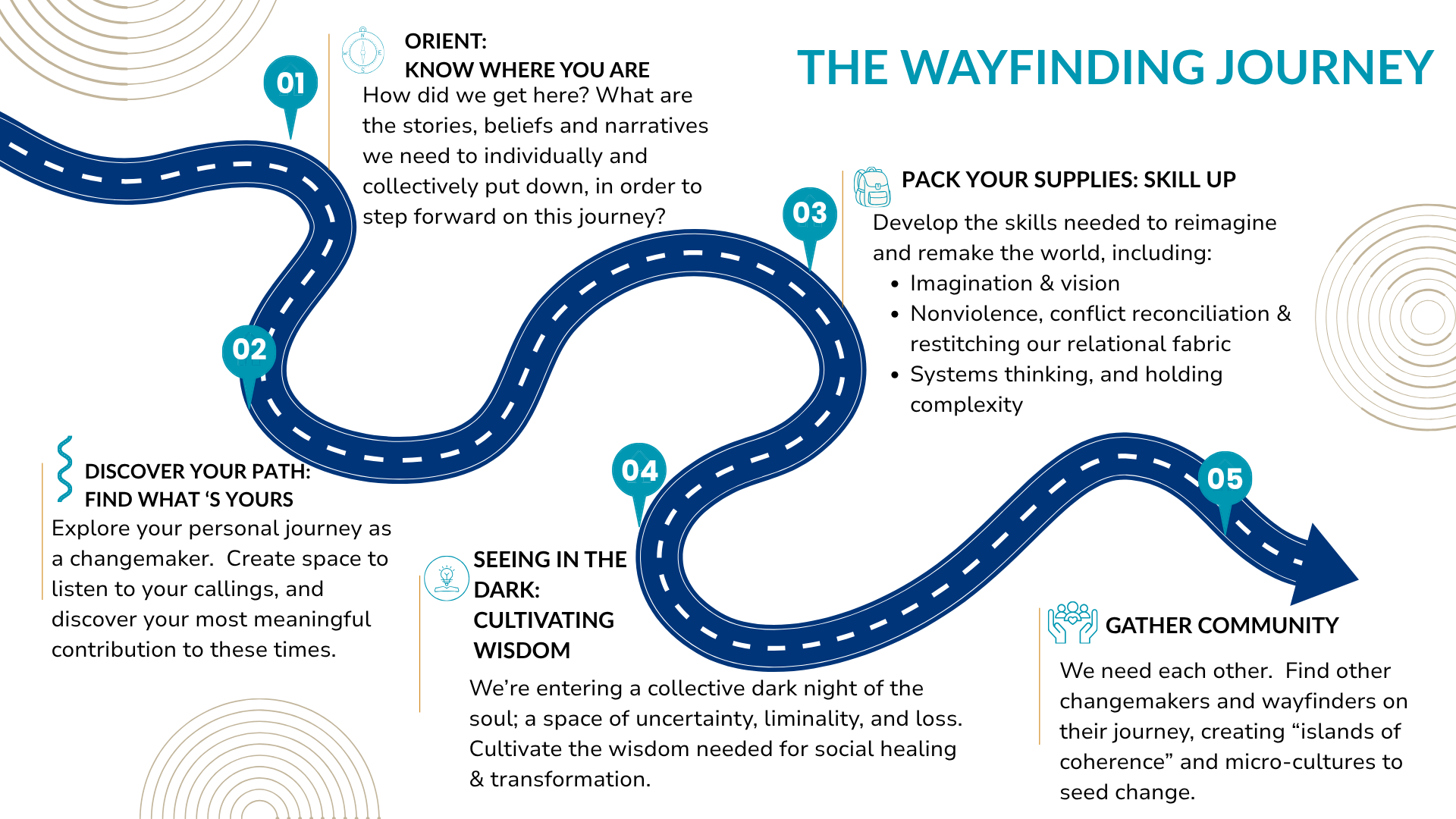
The journey of Cultural Wayfinding outlined below is the journey between the world as it is and the world as it could be.
It’s the space for changemakers in navigating between reality and possibility; between holding what is – a collapsing, hurting world – and midwifing what’s possible – something more just, loving and regenerative in nature.
It’s a journey both inward and outward, as we explore the relationship between stories and self, belief and action, community and conflict.
It may appear linear, but it’s more spiral in nature; each person joining at a different point in the path, each finding what they need next on their journey.
Respect & Gratitude: The term Cultural Wayfinding is inspired by the incredible Polynesian Wayfinders, some of the world's best seafarers. Able to navigate thousands of kilometres across the Pacific Ocean with no modern navigational tools, they were highly attuned to the natural world around them. This connection with the natural world, sensing subtle changes and callings, along with the courage to enter the unknown, pivot and redirect course, are skills this journey honours and is influenced by today.
1. Orienting: On Knowing Where We Are.
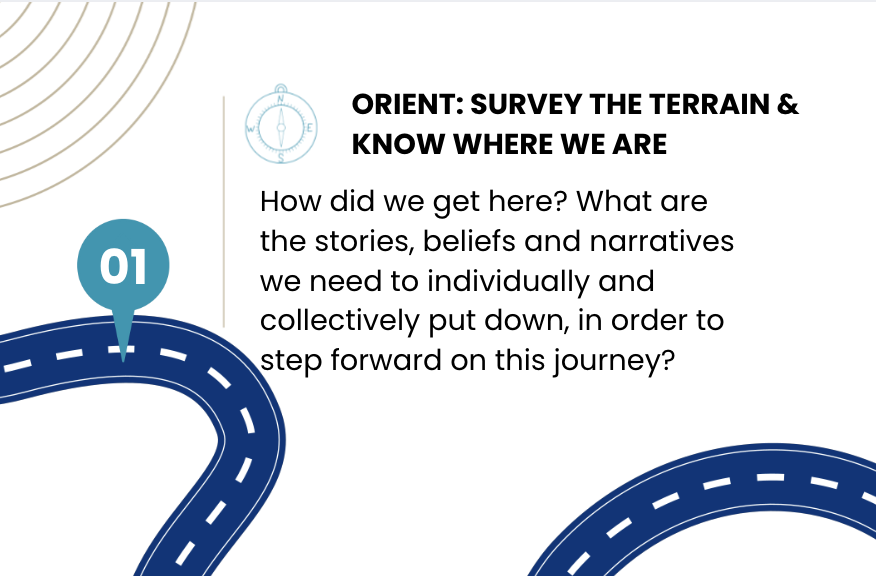
Our first step in the journey of Cultural Wayfinding begins with looking around and asking the pertinent question: how did we get here? Where even is here?
Thomas Berry put it this way: “It’s all a question of story. We are in trouble just now because we do not have a good story. We are in between stories. The Old Story - the account of how the world came to be and how we fit into it - is not functioning properly, and we have not learned the New Story. The Old Story sustained us for a long period of time. It shaped our emotional attitudes, provided us with a life purpose, energized action. It consecrated suffering, integrated knowledge, guided education. We awoke in the morning and knew where we were.”
We need to know where we’ve been, or where we’ve come from, in order to shape the direction of where we’re going. We need to know the stories, beliefs, narratives and ideologies that have shaped our world, so that we don’t unconsciously recreate them. Stories of scarcity, domination, supremacy, control, separation – from each other and the more than human world – shape the world as it is. They shape our relationship to conflict, to change, to our own precious lives and bodies.
Orienting - knowing where we are - is what allows us to look squarely at the old story, at what we’re carrying and where we choose what we wish to put down, and what we wish to carry forward. It’s where we do the foundational work that lets us take that first step into new sands.
It’s the work of Getting Free.
2. Compass Calibration: Finding What’s Yours
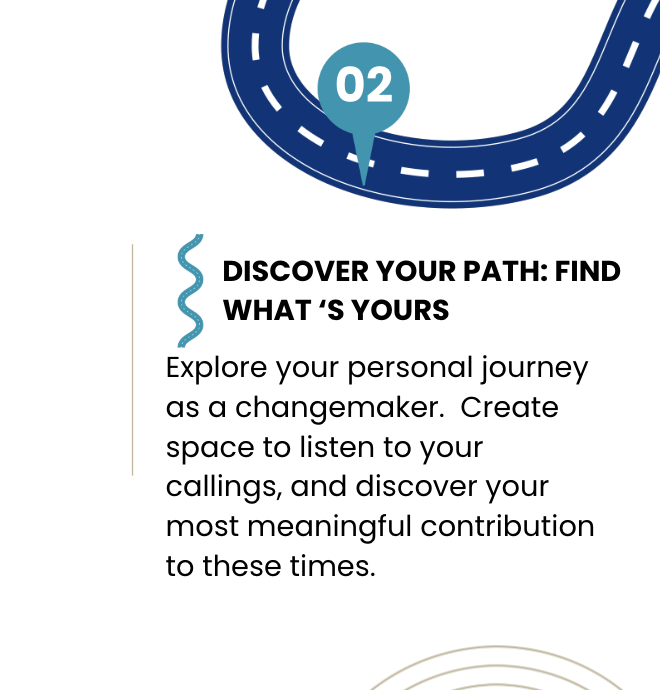
The journey never ends with the first step - and we don’t reach the world as it could be through just looking behind us.
We’ll need, importantly, a compass for the journey. Not a map – that doesn’t exist yet, but something that gives us a sense of direction, some understanding of where we’re going. Our compass is where we find what’s ours to do in this time; it’s what we hone through listening to our callings, our intuitions, our values and our desires.
Our compass is in constant calibration for this journey, it’s one of the most vital tools we’ll have as we wander in an unknown land. It’s the piece that knows it’s not your job to fix the world - however, it is your job to love it, and your work is to find what’s yours to do in this time, not from obligation or what you could do, but from the deep callings & arisings within you.
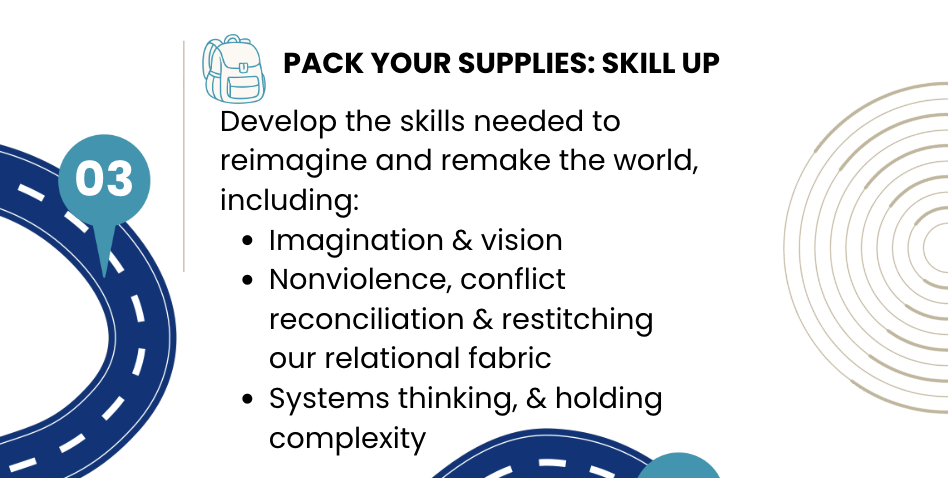
3. Pack Your Supplies: Skilling Up
It’s unlikely you’d enter the wilderness without some sort of supplies (or at least water?) to bring with you – and it’s the same here, culturally and strategically, between worlds. We develop the skills, capacities and resources we need to walk these new paths and carve new tracks.
Skills like imagination and vision, the ability to radically reimagine what could be. To feel and see the path ahead with your heart and mind, before it becomes visible with your eyes.
Skills like conflict reconciliation and nonviolence; our ability to step out of cycles of violence and harm, and instead to understand and respond to conflict as an incubator of possibilities.
And of course, skills like systems thinking, holding complexity and nuance, and working across lines of difference.
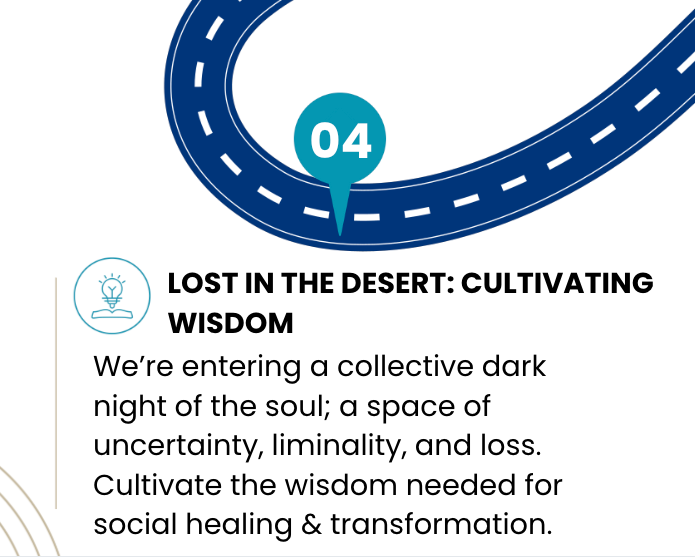
4. Seeing in the Dark: Cultivating Wisdom
In uncharted territory - in the deserts and space of the unknown and uncertain - it’s not uncommon to be filled with fear, loss, grief or the “dark night of the soul”. Indeed, collectively, we are moving through a dark night of the soul as we transition from one form of identity & meaning (partisan, binary, fearful, othered) to one more just, loving and regenerative.
Our way through the desert however isn’t in pushing through, or falling prey to the fears of the dark. It’s in cultivating wisdom, and connection to something larger than ourselves.
Transformation – the path we’re walking in holding space between the world as it is and the world as it could be – is one that requires wisdom. Almost nothing else here matters without it, because while skills can tell us the how of transformation, wisdom is what tells us the when, where, why and whether.
Importantly though, wisdom doesn’t fit neatly into curricular. It can’t be taught in the same way as a skill - but we can create the conditions for it to be gathered, discerned, shared and gained. Wisdom too can be carried collectively through culture, stories, art, literature and science.
5. Gather Community
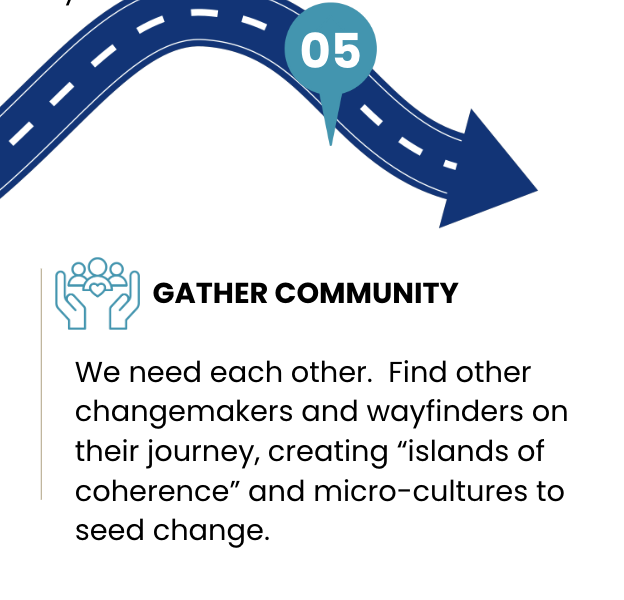
None of us were meant to do this work alone - indeed, none of us can. We are relational and story driven beings, and in the same way we did not arrive on the edge of the world as it is alone, we cannot reach the world as it could be without each other either.
The Nobel-prize winning chemist, Ilya Prigogine, once said “When a complex system is far from equilibrium, small islands of coherence in a sea of chaos have the capacity to shift the entire system to a higher order.”
As we gather on the edges of the unknown, as we cultivate the skills and wisdom more a more just, loving & regenerative world - we must also gather the community. The micro-cultures, the seeds of change, the islands of coherence and sanity which shape the terrain we will journey together.
What’s your next step in the journey?